By Shivam Namdeo Technology & Culture Correspondent
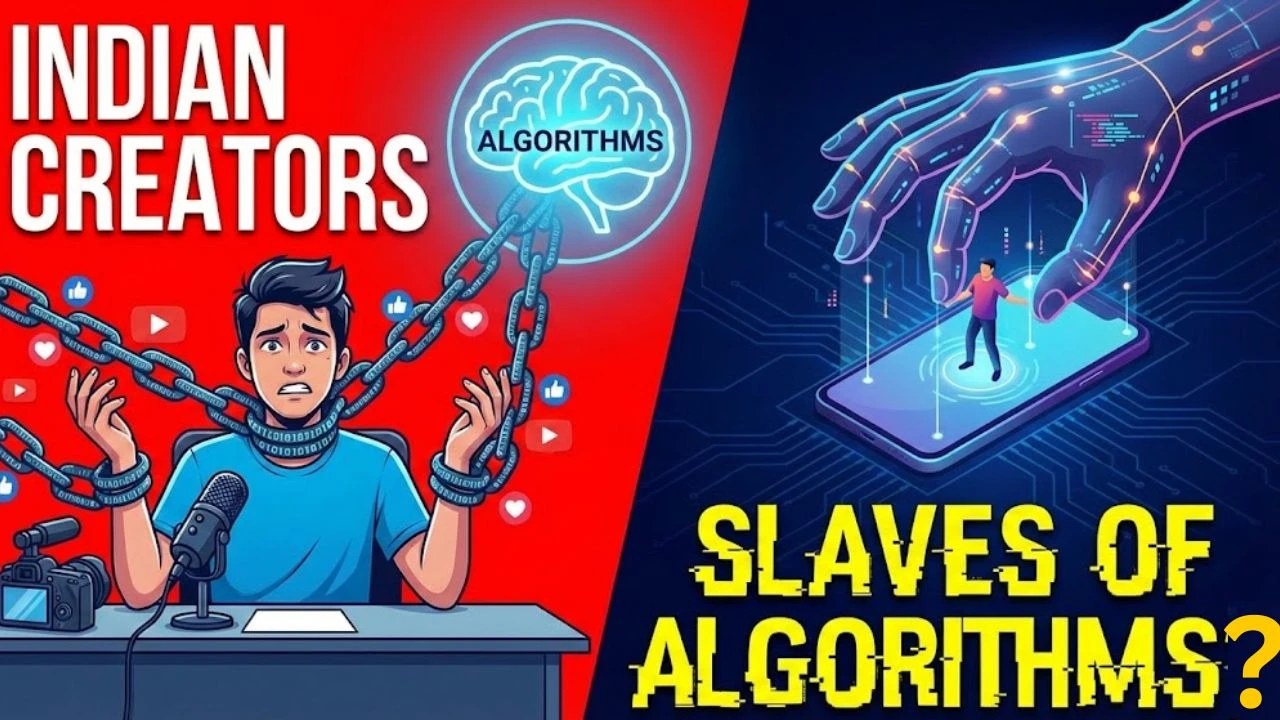
Why Indian Creators Are Slaves of Algorithms: The “dream job” of millions is turning into a digital sweatshop. Behind the glitz of brand deals and viral Reels lies a grim reality: burnout, financial instability, and a master that never sleeps—the Algorithm.
It starts with a dopamine hit. A 15-second video goes viral, the follower count ticks up, and suddenly, a college student in Indore or a homemaker in Madurai feels the rush of stardom. They are told they are “Creators”—the new entrepreneurs of India’s booming digital economy. But scratch the surface of this $350 billion industry, and you don’t find freedom. You find feudalism.
For India’s 2.5 million active content creators, the boss isn’t a person. It is a black-box code—an algorithm that dictates when they work, what they say, how they look, and whether they get paid. It demands absolute obedience, punishing a single day of rest with irrelevance.
As we move deeper into 2025, the Indian creator economy is facing a reckoning. The “Influencer Dream” is rapidly revealing itself to be a golden cage, where creators are not masters of their fate, but serfs on digital land owned by Silicon Valley giants.
The Invisible Boss: “Feed Me or Fade Away” (Why Indian Creators Are Slaves of Algorithms)
If you ask a traditional employee to work 16 hours a day, seven days a week, without a guaranteed salary, they would call it exploitation. In the creator economy, it’s called “consistency.”
The mechanism of control is subtle but brutal. Platforms like Instagram (Meta) and YouTube (Google) have shifted from simple chronological feeds to “discovery engines.” These engines prioritize one metric above all: Relationship Signals.
To stay visible, a creator cannot just post content. They must engage. They must reply to comments within the first hour. They must post Stories to keep the “bubble” active. They must upload Reels to court new eyes and carousels to nurture old ones.
“The algorithm doesn’t care if you are sick, if you are grieving, or if you just need a break,” says a lifestyle creator from Mumbai with 400k followers who requested anonymity. “I missed posting for three days when I had dengue last year. My reach tanked by 60% when I returned. It took me three months to climb back up. I realized then: I don’t own my audience. The platform does.”
This is the “1.2 FTE (Full-Time Equivalent) Problem.” Most successful creators are doing the work of a scriptwriter, actor, editor, community manager, and data analyst simultaneously—often amounting to 120% of a standard full-time job, with zero benefits.
The “Shorts” Trap
The pivot to short-form video (Reels, Shorts) has exacerbated this slavery.
- Prajakta Koli (MostlySane), one of India’s top creators, famously noted the jarring shift: “What do you mean 15 seconds? My videos are 12 minutes long!”
- The pressure isn’t just to condense; it is to hook. Creators are forced to abandon nuance for noise, creating “engagement bait” just to stop the scroll.
- Nuanced storytelling is punished; high-stimulus chaos is rewarded.
The 8% Reality: A Wealth Gap Wider Than the Grand Canyon
Headlines scream that the Indian creator economy will be worth $1 trillion by 2030. But who is actually getting that money?
Recent data from 2024-2025 reveals a startling “Pareto distribution” on steroids:
- Total Active Creators: ~2.5 million (creators with >1,000 followers).
- Effective Monetizers: Only 8-10%.
- The “Middle Class” Squeeze: The vast majority of creators fall into a “missing middle”—earning too little to sustain a career but working too hard to treat it as a hobby.
While top-tier stars sign Bollywood movies, the mid-tier creator is fighting for barter deals (free products instead of cash). This financial precarity makes them even more desperate to please the algorithm. A change in the ranking logic can wipe out a month’s income overnight.
Real-World Data: An internal report from a leading influencer marketing agency in Bengaluru showed that in 2024, organic reach for business accounts dropped by 65% after an algorithm update. For a creator relying on ad revenue, that’s a 65% pay cut with no warning and no HR department to complain to.
“Digital Housewives” and the Regional Grind
One of the most overlooked demographics in this digital sweatshop is the Indian homemaker.
Sociologist Sucharita Kanjilal terms them “Digital Housewives.” From Pune to Patna, women are turning their kitchens into studios, filming recipes, cleaning hacks, and parenting tips.
- The Promise: Financial independence and “work from home” flexibility.
- The Reality: They are performing double labor—domestic chores plus digital production.
Furthermore, the algorithm has a language bias. While India has over 900 million internet users, recommendation engines still struggle to effectively categorize and monetize regional content (Tamil, Bengali, Marathi) compared to Hindi and English. A creator in Madurai offering high-value financial advice in Tamil often faces a “monetization ceiling” because the ad rates (CPM) for regional content are significantly lower, forcing them to produce three times the volume of an English-speaking creator to earn the same revenue.
Shadowbanning: The Silent Firing
Imagine showing up to work, doing your job, but your boss has secretly muted you in all meetings. You speak, but no one hears. This is Shadowbanning.
It is the creator’s worst nightmare: a sudden, unexplained drop in visibility because the algorithm flagged content as “inappropriate” or “low quality.”
The Case of Leeza Mangaldas: Leeza Mangaldas, a prominent sex-education content creator, has been vocal about this battle. Despite creating educational content on health and biology, her account is frequently flagged by puritanical AI filters that cannot distinguish between “sex education” and “sexual solicitation.”
“I deleted all the content flagged in order to get my account status back… This is the case for most of us,” Mangaldas noted in a recent interview.
When an algorithm can silence an educator because it doesn’t understand context, it isn’t just a technical glitch; it’s a suppression of speech. Creators live in fear of using the wrong keyword or hashtag, self-censoring their work to appease a machine they don’t understand.
ALSO READ Why 9 out of 10 Indian Startups Fail: The Bitter Truth Behind the Hype
The Burnout Epidemic: “I Need to Disconnect to Survive”
The mental toll of this “always-on” culture is visible even at the top. Bhuvan Bam, the first Indian YouTuber to cross 10 million subscribers, has spoken openly about the “loop” of validation and the necessity of disconnecting.
“It’s like a loop; it’s difficult to get rid of… I completely disconnect for a week before I have to shoot an episode,” Bam shared.
But while Bam has the financial cushion to take a week off, a micro-influencer with 50,000 followers does not.
- The Fear of Irrelevance: “If I don’t post today, they will forget me.”
- The Comparison Trap: Watching peers go viral while your own high-effort content flops creates a cycle of envy and self-doubt.
- Algorithmic Anxiety: The constant refreshing of analytics apps—checking views, likes, and shares—has become a compulsive behavior, triggering dopamine highs and depressive lows.
The New Threat: The “Perfect” AI Rival
As if the algorithm wasn’t enough, Indian creators now face a new competitor: The AI Influencer.
Enter Kyra (India’s first Meta-Influencer) or Radhika Subramaniam.
- They never sleep.
- They never burnout.
- They never complain about low pay.
- They look perfect in every frame.
Brands are beginning to experiment with these virtual avatars. Why hire a human who might get involved in a controversy or demand a mental health break, when you can hire a pixel-perfect avatar that posts exactly what you want, when you want? This pushes human creators further into the corner. To compete with AI, they are forced to become more machine-like—more consistent, more filtered, and more predictable.
ALSO READ
Meet Manas Ranjan Dash: How an Odisha Farmer Battled Spondylitis to Build a Mushroom Empire
Conclusion: Breaking the Wheel
The Indian creator economy is at a tipping point. The “gold rush” phase is over; the “industrialization” phase has begun. We are witnessing the rise of Digital Feudalism, where platforms are the landlords and creators are the sharecroppers.
So, is there a way out?
The smartest creators in 2025 are realizing that Algorithm = Volatility. They are trying to “own” their audience:
- Moving off-platform: Building email lists, WhatsApp channels, and communities on platforms like Discord where they control the reach.
- Selling Products, Not Attention: Launching D2C brands (merchandise, courses, consulting) to rely less on ad revenue and brand deals.
- Unionization: There are growing whispers of creators needing collective bargaining power to demand transparency from platforms regarding shadowbans and pay rates.
The Takeaway for You: The next time you scroll past a Reel and think, “I wish I had their life,” pause. You are looking at a performance. Behind that smile is a grueling fight for survival against a code that treats human creativity as just another data point.
CTA: Are you a creator struggling with algorithmic burnout? Or a viewer who has noticed your favorite creators changing their style to fit the “trend”? Share this story and tag a creator who deserves to be seen for their work, not just their metrics. Let’s start a conversation about putting the human back in the creator economy.