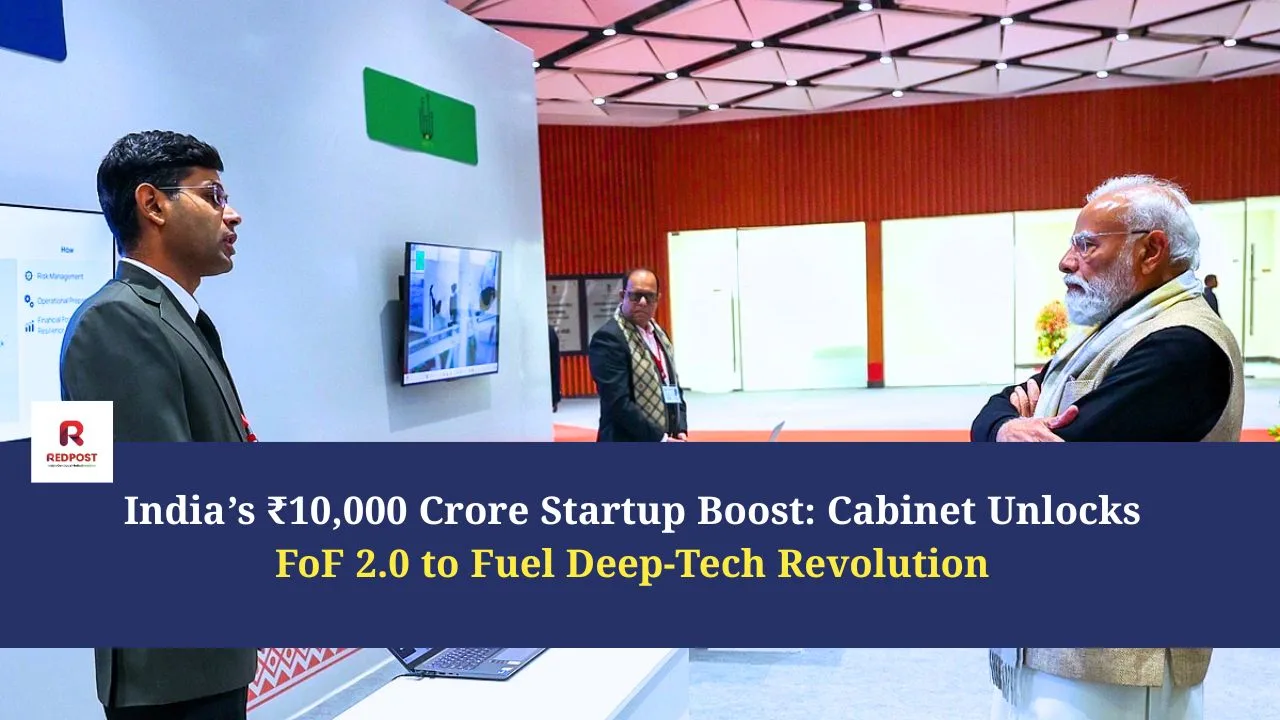
FoF 2.0- In a move set to redefine the trajectory of the world’s third-largest startup ecosystem, the Union Cabinet has greenlit the ₹10,000 crore Startup India Fund of Funds 2.0 (FoF 2.0). By pivoting focus toward high-risk deep-tech and innovative manufacturing, New Delhi isn’t just funding companies—it is engineering the next decade of India’s industrial sovereignty.
The ₹10,000 Crore Blueprint for Innovation
On February 13, 2026, the Union Cabinet, chaired by Prime Minister Narendra Modi, signaled a massive shift in India’s economic strategy. The approval of FoF 2.0, backed by a ₹10,000 crore allocation from the 2025-26 Union Budget, marks a transition from general digital services toward “hard” innovation.
Unlike direct investment schemes, this “Fund of Funds” model acts as a catalyst. It does not invest directly in startups but commits capital to Alternative Investment Funds (AIFs). These venture capital funds, in turn, leverage the government’s commitment to raise even larger pools of private capital, effectively “crowding in” investment for sectors that traditional banks often find too risky to touch.
An Empowered Committee will oversee the fund’s operations, ensuring that the capital is deployed with strategic precision rather than bureaucratic lethargy.
Beyond the Metros: The Priorities of FoF 2.0
While the first iteration of the Fund of Funds (launched in 2016) laid the groundwork for India’s unicorn boom, FoF 2.0 is designed for a more mature, complex market. The priorities have shifted toward:
- Deep-Tech & AI: Supporting breakthroughs in semiconductors, quantum computing, and generative AI.
- Innovative Manufacturing: Aligning with the ‘Make in India’ vision to foster hardware startups that can compete with global giants.
- The “Bharat” Factor: A deliberate push to fund startups in Tier-2 and Tier-3 cities, ensuring that innovation isn’t confined to Bengaluru, Gurgaon, or Mumbai.
- Patient Capital: Providing long-term funding for R&D-heavy sectors that require 7-10 years to reach commercial viability.
“The focus on deep-tech and manufacturing is exactly what India needs to transition from a service-led economy to a product-led powerhouse,” says a senior analyst at a leading domestic VC firm. “This fund provides the ‘patient capital’ that the private sector is often too impatient to provide alone.”
Evolution of the Ecosystem: FoF 1.0 vs. FoF 2.0
To understand where we are going, we must look at where we started. In 2016, India had barely 500 recognized startups. Today, that number has surged past 200,000.
| Aspect | FoF 1.0 (2016 Launch) | FoF 2.0 (2026 Launch) |
| Total Corpus | ₹10,000 Crore | ₹10,000 Crore |
| Primary Focus | Fintech, SaaS, E-commerce | Deep-tech, Space-tech, Robotics, Manufacturing |
| Reach | Mostly Metro-centric | Explicit focus on Non-Metro growth |
| Ecosystem Maturity | ~500 recognized startups | 200,000+ DPIIT-recognized startups |
| Key Achievement | Created 100+ Unicorns | Aiming for Global IP and Self-reliance |
The success of the first fund is undeniable. It committed capital to 145 AIFs, which in turn fueled over 1,370 startups. By supporting first-time founders and providing a safety net for domestic VCs, it proved that Indian startups were a viable asset class.
Sustaining Momentum in a Thriving Landscape
The timing of FoF 2.0 is critical. India recently raised the turnover threshold for startup recognition to ₹200 crore, allowing more mature companies to benefit from tax incentives and procurement norms. In 2025 alone, over 49,400 new startups were recognized by the DPIIT, showcasing a relentless entrepreneurial spirit.
The fund is expected to act as a lifeline for sectors like Clean-tech and Space-tech, which are vital for the Viksit Bharat @2047 vision. By strengthening domestic VC funds, the government is also reducing India’s dependence on volatile foreign capital, ensuring that the “mind-to-market” journey happens entirely on Indian soil.
What This Means for the Modern Founder
For entrepreneurs building the next generation of social-tech platforms or AI-driven logistics—like those at the helm of emerging players like RedPost—FoF 2.0 represents a more accessible venture capital landscape. The influx of ₹10,000 crore into the AIF ecosystem means more “dry powder” is available for early-growth stages, reducing the dreaded “Series A crunch.”
If you are a founder, the message from New Delhi is clear: Solve hard problems. Whether it’s robotics in agriculture or sustainable tech in manufacturing, the government is willing to share the risk of your innovation.
The Bottom Line
The Startup India Fund of Funds 2.0 is more than just a budgetary allocation; it is a strategic bet on Indian intellect. As the nation eyes a $5 trillion economy and beyond, the focus on deep-tech ensures that India won’t just use the technology of the future—it will own it.
Are you an entrepreneur or investor looking to navigate this new landscape? Stay tuned to our ‘Startup Pulse’ section for deep dives into how to access these funds and what the new AIF guidelines mean for your business.
ALSO READ Why 9 out of 10 Indian Startups Fail: The Bitter Truth Behind the Hype