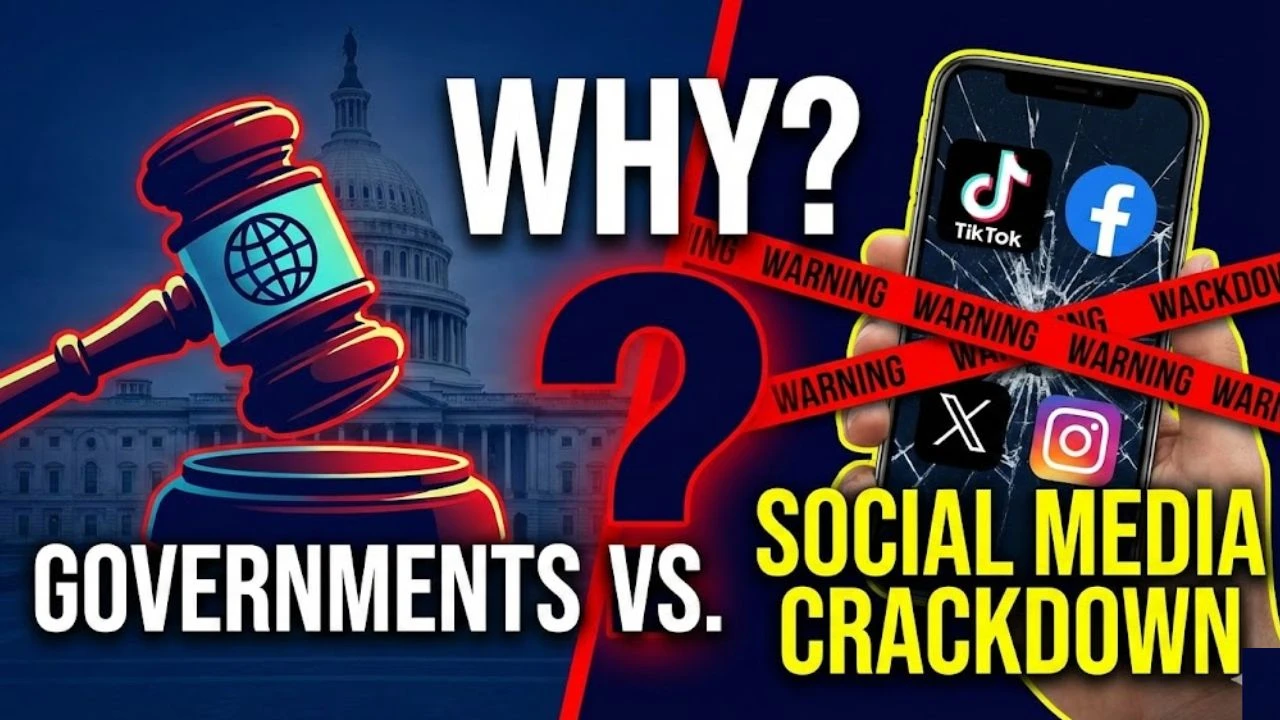
Why Governments Worldwide Are Cracking Down on Social Media Platforms- nearly two decades, social media platforms operated like sovereign states. They wrote their own laws, policed their own borders, and printed their own money in the form of user data. Silicon Valley’s mantra—”move fast and break things”—was accepted as the price of progress.
But the mood has shifted. The era of digital laissez-faire is dead.
From Canberra to Brasilia, and Washington to Brussels, governments are no longer asking Big Tech to self-regulate; they are forcing them to heel. In late 2024, the world watched in stunned silence as a Brazilian judge pulled the plug on X (formerly Twitter) for a month. In August 2024, Telegram founder Pavel Durov was arrested on a tarmac in Paris, shattering the illusion that tech CEOs are untouchable. And just last month, Australia’s world-first ban on social media for under-16s officially kicked into high gear.
This isn’t just a series of isolated skirmishes. It is a coordinated global counter-offensive. But why now? And more importantly, what does this mean for the future of the open internet?
The Tipping Point: Why the Hammer is Dropping Now (Why Governments Worldwide Are Cracking Down on Social Media)
The crackdown is driven by a convergence of three critical crises that have forced legislators to act: a mental health epidemic among the young, the weaponization of disinformation, and the hardening of national security borders.
“We are seeing a reassertion of the Westphalian state over the digital cloud,” says Dr. Aruna Roy, a digital policy analyst based in New Delhi. “Governments realized that if they don’t regulate algorithms, the algorithms will regulate society.”
The crackdown generally falls into three distinct buckets.
1. The “Save the Children” Mandate
The most emotionally charged battleground is youth safety. For years, whistleblowers like Frances Haugen warned that platforms knew their products were toxic to teenagers. Now, patience has run out.
Australia has led the charge with its Social Media Minimum Age Act, effective from December 2025, which bans children under 16 from holding accounts on platforms like TikTok, Instagram, and Snapchat. Unlike previous attempts at regulation, this law puts the burden—and the massive fines (up to AUD 50 million)—squarely on the tech giants, not the parents.
Similarly, the UK’s Online Safety Act is now fully operational, threatening jail time for tech executives who fail to protect children from harmful content like self-harm videos and cyberbullying. The message is clear: the mental health of the next generation is no longer an acceptable externality of the engagement economy.
2. The Battle for Truth and Sovereignty
If the youth bans are about safety, the clashes in Brazil and Europe are about power.
The standoff between Brazil’s Supreme Court and Elon Musk in late 2024 was a watershed moment. When X refused to block accounts accused of spreading election disinformation and failed to appoint a legal representative, Justice Alexandre de Moraes didn’t blink. He banned the platform in one of its largest markets. Musk eventually capitulated, paid the fines, and appointed a representative.
The lesson? Even the world’s richest man must follow local laws.
Meanwhile, the European Union is using its Digital Services Act (DSA) as a battering ram. The EU has already opened formal investigations into X and other platforms for deceptive design patterns and failing to tackle disinformation. Unlike the slow-moving courts of the past, the DSA allows the EU to impose fines of up to 6% of global turnover—billions of dollars—for non-compliance.
3. The National Security Firewall
The third driver is geopolitical. The borderless internet is fracturing into a “Splinternet” as nations view foreign-owned platforms as potential spy balloons.
The United States’ ongoing saga with TikTok exemplifies this. Despite delays and legal challenges, the bipartisan consensus remains that a Chinese-owned app on 170 million American phones constitutes a national security threat. India was the pioneer here, having banned TikTok and dozens of other Chinese apps back in 2020 following border skirmishes.
What started as trade protectionism has evolved into digital defense. Governments are increasingly demanding data localization—requiring user data to be stored on servers within their physical borders—to prevent foreign surveillance.
The Economic Angle: Paying the Piper
Beyond safety and security, there is a simple economic reality: news publishers are dying, and governments are intervening to save the “fourth estate.”
- Canada’s Online News Act
- Australia’s News Media Bargaining Code
- California’s Journalism Preservation Act
These laws force Google and Meta to pay for the news content that drives traffic to their platforms. While Meta responded by blocking news links in Canada, the legislative trend is spreading. Governments view a healthy, funded press as essential to democracy, and they are using regulation to redistribute digital ad revenue back to newsrooms.
The Risks of Over-Correction
However, civil liberty groups warn that the pendulum might swing too far.
- Privacy vs. Age Verification: To enforce age bans (like in Australia), platforms must verify the identity of all users. This could mean uploading government IDs or face scans, creating a privacy nightmare.
- Censorship Creep: Laws designed to stop “disinformation” can easily be weaponized by authoritarian regimes to silence dissent. If Brazil can ban X for defying court orders, what stops a dictatorship from banning WhatsApp to stop protestors from organizing?
- Encryption Under Fire: The arrest of Pavel Durov in France raised uncomfortable questions about liability. If a CEO is criminally responsible for what users do on their platform, will platforms be forced to break end-to-end encryption to monitor chats?
The Verdict: A New Digital Contract
The “Wild West” days of the 2010s—where tech giants apologized for mistakes but changed nothing—are over. We are entering a new phase of Coercive Compliance.
Tech companies are facing a choice: adapt to a patchwork of fragmented local laws, or exit markets entirely. For the user, the internet is becoming safer, but also smaller, more gated, and more heavily policed.
ALSO READ Why Indian Creators Are Slaves of Algorithms
What This Means For You
The internet you use in 2026 will look very different from the one you used in 2023. Expect:
- More ID checks: You will likely need to scan an ID to use social media soon.
- Geofenced content: You may see fewer posts from international sources as algorithms tighten to comply with local laws.
- Subscription models: As platforms lose ad revenue from tracking restrictions, expect more “Pay for Privacy” models.